What is pairs cricket?
Pairs cricket is a junior format in which batters go out two at a time and bat for a fixed number of overs, whatever happens. Getting out doesn’t send you back to the pavilion. It costs your team runs instead. That way every child gets a fair go with the bat and the game finishes on time. It is widely played in the UK at under-9 and under-11 level, in New Zealand, and in Australian entry-level programmes.
The usual rules (UK style)
Most UK county and club pairs rules follow the same pattern:
- Each team starts on 200 runs.
- The team is split into pairs. Each pair bats for a set block of overs: 2 overs in short 8-over games, 4 overs in most under-11 games of 16 to 20 overs.
- When a batter is out, 5 runs come off the total. The batter stays in, and the partner usually faces the next ball. After a run out, competitions differ on who faces.
- Wides and no-balls are worth 2 runs, plus any runs taken, and usually aren’t bowled again, except in the last over of the innings, when an extra ball is bowled.
- LBW is normally not given, unless the batter deliberately blocks the ball with a leg.
- The higher final score wins. On a tie, many rules use fewer wickets lost.
Australian entry-level pairs is different. In Cricket Australia’s entry-level game, batters still bat in pairs (4 overs each in a 12-over game), but a wicket gives 5 bonus runs to the fielding team instead of taking runs off the batting team. Wides and no-balls aren’t bowled again; the batter gets a free hit off a tee instead. Some versions also have a zone where hits score double. Check which version your child plays.
The score: one line to remember
Final score = 200 + runs off the bat + extras − (5 × wickets)
Worked example. A team of 8 bats in 4 pairs of 4 overs. Off the bat they score 74, they get 11 in extras, and 6 wickets fall: 200 + 74 + 11 − 30 = 255. The other team scores 81 with 7 extras and loses 9 wickets: 200 + 81 + 7 − 45 = 243. The first team wins by 12 runs.
Because of the start score, a pairs total can look high even if nobody hit much. That’s normal.
How to fill in a pairs score sheet
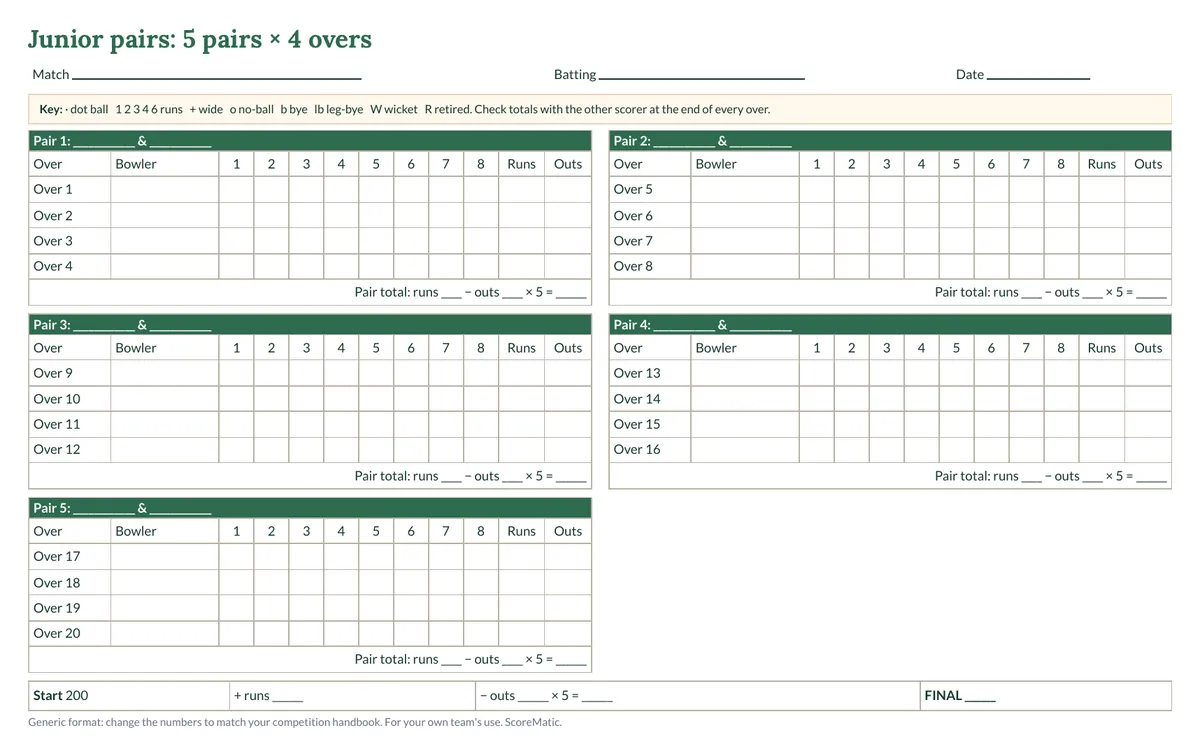
A pairs sheet is laid out in blocks, one for each pair, with that pair’s overs beside it.
- Write the pairs in batting order, and the bowler’s name at the top of each over.
- Each ball: in the striker’s box, write a dot, the runs, W for out, or the mark for a wide or no-ball. Write the same in the bowler’s over.
- At the end of each over, write the running total (starting from 200) and the wickets in that over. Agree the running total with the other scorer before the next over starts. Most mistakes are caught here.
- At the end of each pair’s block, write the pair total: runs and extras scored minus 5 for each wicket. This shows each pair’s contribution, which coaches like to share.
- At the end: add up the runs, extras and wickets, and check that the formula above matches your last running total.
The cross-check. Add up all the pair totals and add 200. It should equal the final score. If it doesn’t, compare your over-by-over running totals with the other scorer’s, and find the first over where you disagree.
Is there an app?
Some leagues use one. A paper sheet or a spreadsheet works just as well, and doesn’t need a signal at the ground.
Printable pairs sheets
The ScoreMatic Junior Cricket Score Sheets pack (printable, A4 and US Letter) includes pairs sheets for 4 pairs × 4 overs and 5 pairs × 4 overs, with pair totals and the start-on-200 sum laid out step by step. The ScoreMatic Cricket Scorebook has a pairs setup that keeps the running total and pair totals for you, in Google Sheets.
See the score sheets on Etsy Also on Gumroad Scorebook spreadsheet on Etsy
FAQ
- What is pairs cricket?
- A junior format in which batters go out two at a time and bat for a fixed number of overs. Getting out costs the team runs instead of ending the batter’s turn.
- Can a pairs total go below 200?
- Yes, if the pair loses more runs to wickets than it scores. That’s why the start score exists.
- Who faces after a wicket in pairs cricket?
- Usually the partner. Check your competition’s rules for run outs.
- Is there an extra ball for a wide in pairs cricket?
- Usually only in the last over of the innings.
Sources (our own summary, not their text): ECB, Kwik Cricket Rules (2020); ECB, “Five things to know: women’s soft ball cricket festivals”; Shropshire Cricket Board, Under 11 Hard Ball Pairs and Under 10/11 Incrediball Pairs league rules 2025; Norfolk Cricket Board, U11 Girls Pairs Hundred rules; Cricket Australia, Cricket Blast Game format and rules (2023). Rules vary by county and league; follow yours.
ScoreMatic is not affiliated with any league, association, board or official programme.