Stage 1 is the first level of junior club matches in Australia, usually for under-10 and under-11 teams. It looks like normal cricket, with one big difference that trips up new scorers: getting out doesn’t end a batter’s turn. Each batter faces a set number of balls and then retires, so every child gets the same bat. Here is everything the scorer needs, based on Cricket Australia’s national Stage 1 format and the match-day rules that associations publish for it.
Associations adjust these rules. Treat this page as the national starting point and check your association’s match-day rules for the differences, which we list below.
The game at a glance
- Teams: 7 a side. At least 5 are needed to play, and up to 9 can be in the team, with 7 on the field at once.
- Innings: one innings each of 20 overs (120 balls).
- Overs: at most 6 balls. Wides and no-balls are not bowled again, so an over is always 6 deliveries.
- Bowling: everyone bowls, up to 4 overs each, all from one end for the whole game.
- Keepers: two keepers, 10 overs each. If more than 7 players turn up, fielders rotate on each over.
- Ground: a 16 m pitch and a boundary of up to 40 m. Many competitions use a shorter boundary for girls’ games.
- Ways out: bowled, caught (including caught and bowled), run out, stumped and hit wicket. No LBW. Some associations also leave out stumpings.
How many balls before a batter retires?
The 120 balls are shared equally, rounded down:
| Players batting | Balls each |
|---|---|
| 5 | 24 |
| 6 | 20 |
| 7 | 17 |
| 8 | 15 |
| 9 | 13 |
- Every ball counts, wides and no-balls included.
- The batter retires the moment they reach their number, even mid-over. They don’t wait for the end of the over.
- With 7 or 9 players the sums don’t come out even (7 × 17 = 119). The batter on strike at the end faces the leftover balls. Some associations write this out instead (for example “six batters face 17 and one faces 18”).
- Retired batters are recorded as retired not out.
Scorer’s tip: before the first ball, cross out the boxes past your number on the score sheet. When a batter fills their last box, tell the umpire or coach straight away. Many clubs ask the scorer to warn the coach when a batter has 3 balls left.
Outs
There is no limit on dismissals. When a batter is out:
- Mark the ball W and add one to their outs count. They keep batting.
- The batters swap ends, so the partner faces the next ball. After a run out, the batter who was not out faces the next ball.
- Note how they were out if your sheet asks for it.
The 4-runs-per-wicket option. The national format lets associations add a cost for getting out: 4 runs for each dismissal are added to the bowling team’s total at the end of the innings. Many associations use it. If yours does, total the outs at the end, multiply by 4, and add that to the other team’s score. Our free sheet has a line for it.
Some older club scorebooks show a different method, such as runs per out. Use whatever your association’s match-day rules say.
Wides and no-balls
- They are not re-bowled: the over stays at 6 deliveries.
- They count as a ball faced by the striker.
- They go to extras and are charged to the bowler. The national format doesn’t say what they are worth; most match-day rules make them 1 run each, plus any runs taken. Check yours.
Ends and strike
Bowling is from one end only. The national format doesn’t say what happens at the end of an over, and associations differ. Some (for example the WA metropolitan competition) have the batters change ends after every over, so the strike rotates as it would in normal cricket. Ask the umpire at the start. It decides whose box the first ball of each over goes in.
Scoring a Stage 1 innings, step by step
- Write the batting order and cross out the boxes past your balls-each number.
- Each ball: write the mark in the striker’s next box and in that over’s ball box.
- After an odd number of runs (1 or 3), the batters have swapped, so the other batter faces next.
- After a dismissal: W, add one to outs, and swap the strike (except after a run out, as above).
- When a batter fills their last box: they retire, and the next batter comes in at that end.
- End of the innings: runs off the bat + extras = total. If your association uses it, outs × 4 go to the other team.
Worked example. A 7-player team scores 96 runs off the bat with 14 extras and is out 6 times. Their total is 110. If dismissals cost 4 runs, the fielding team adds 6 × 4 = 24 to their own total at the end of the innings.
Common differences between associations
- Ball counts written out for uneven teams (7 and 9 players).
- No stumpings, in some competitions.
- Strike changing at the end of each over.
- Shorter games (15 overs) with smaller ball counts. Many leagues use an equal share of 90 balls: 18, 15, 12, 11 or 10.
- Girls’ competitions with their own age bands and boundary sizes.
Free Stage 1 score sheet
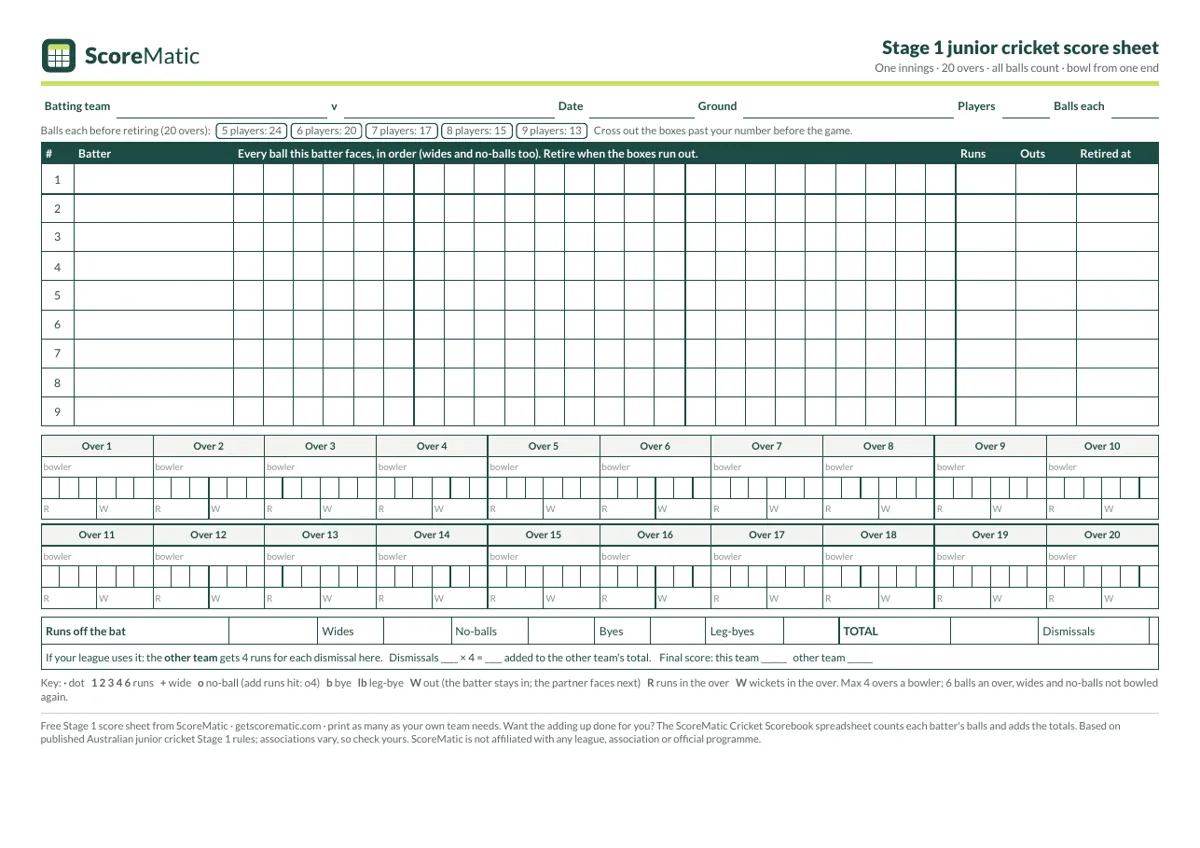
Our one-page sheet is laid out for this format. There is a row of boxes for every ball each batter faces, the balls-each table printed at the top, an outs column, and the 4-runs-per-wicket line. Download it free (A4 or US Letter).
Let the spreadsheet do the adding up
The ScoreMatic Cricket Scorebook has a Stage 1 setup. Choose the number of players and it counts every batter’s balls, retires them on the right ball and adds the dismissal runs, all in Google Sheets on your phone.
FAQ
- Do wides count as a ball faced in Stage 1?
- Yes. Every ball counts towards the batter’s number, wides and no-balls included.
- Is there LBW in Stage 1?
- No.
- What happens when a Stage 1 batter is out?
- They stay in. Mark the out, and the partner faces the next ball (unless it was a run out). Some associations add 4 runs to the other team for each out.
- When does a Stage 1 batter retire?
- As soon as they have faced their allotted balls (17 in a 7-player team), even in the middle of an over.
- Do the batters change ends at the end of an over in Stage 1?
- It depends on your association. Bowling is from one end only, and many associations have the batters change ends after every over so the strike rotates. Ask the umpire before the game.
Sources (read 15 and 19 Nov 2026; our own summary, not their text):
- Cricket Australia, Australian Cricket Junior Formats, Stages 1, 2, 3 (national format document; copy hosted by AGSV).
- Newcastle Junior Cricket Association, 2025-26 Stage 1 Mixed and All-Girls 20 Over Match Day Rules.
- Metropolitan Junior Community Cricket (WA), Stage 1 Match Day Rules: written-out ball counts, no stumpings, changing ends each over.
- Cricket Australia, Play Cricket, Play Junior Club Cricket: the stage descriptions.
ScoreMatic is not affiliated with any league, association, board or official programme.